


INTRODUCTION
Our knowledge of London’s food heritage dates back to Roman times when archaeological evidence reveals how Roman Londoners ate shellfish such as oysters, mussels and whelks. Over the centuries, food was sold on the streets by street sellers - or hawkers - as well as in the marketplaces.
The variety of what was on sale expanded as different communities settled in London, from the oxtail and chips brought by the Huguenots to the salt beef and rye bread of Eastern European Jewish immigrants.
The last century has seen the spread of Bengali cuisine and restaurants, followed by Somalian and Ethiopian cafés and the Korean, Vietnamese, and Chinese eateries that are popular in Petticoat Lane today. The Lane and Wentworth Street and Goulston Street now hosts a truly international food market catering for the City workers, local residents and student population, and maintains its character as a vibrant showcase of global tastes and local histories which you may see as you wander around today.
THE HUGUENOTS
The French Protestant refugees, known as the Huguenots, who settled in large numbers in the area from the early 1680s, introduced several culinary traditions and ingredients to the area. Oxtail soup became a staple food, reflecting the Huguenots' resourceful cooking methods. Caraway seeds were used in baking and cooking, adding distinctive flavours to various dishes. Their fondness for garlic-infused sausages brought new flavours to the street, together with some anti-French complaints about the aroma.
The Huguenots also introduced various pickling techniques, enhancing food preservation and adding tangy flavours to the local diet. They used the fruit of the mulberry trees – primarily planted to support silk production – to make jams and desserts.
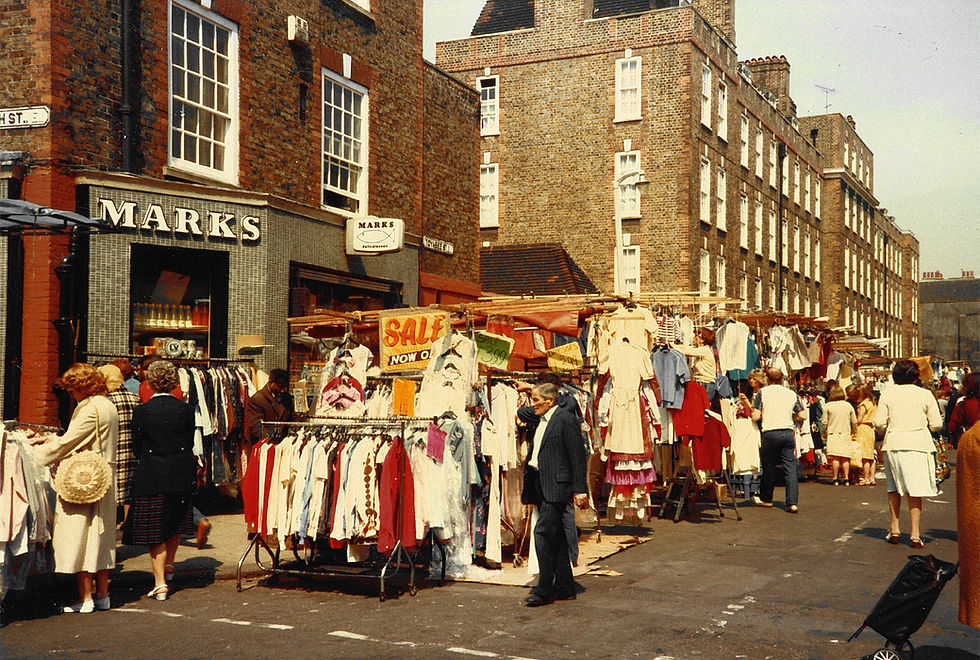
Copyright Clara Ely & Tower Hamlets Local History Library & Archives
JEWISH FOOD HERITAGE
In the late 19th and early 20th centuries, Jewish immigrants from Eastern Europe settled in the Petticoat Lane area, bringing with them their vibrant food culture. Fleeing persecution, they brought culinary traditions that thrived in the area’s bustling markets and backstreets. The choice and preparation of ingredients followed kosher rules, a set of religious dietary laws that established which food was fit to eat.
Street vendors and kosher delicatessens served up staples like bagels, salt beef, challah, and gefilte fish that were nourishing, affordable, and fitted kosher laws. Shops like Kossoffs Bakery in Wentworth Street became known for their challah and rye bread, while the legendary Beigel Bake on nearby Brick Lane gained fame for its hot salt beef bagels with mustard and pickles. Delis like Marks of the Lane at 57–59 Wentworth Street became famed for its smoked salmon herring and bagels and was featured in a cameo in Carol Reed’s film A Kid for Two Farthings (1955).
Blooms Restaurant, originally in Old Montague Street and later at Whitechapel High Street until it closed in 1996, was one of London’s most iconic kosher eateries, serving classic Jewish fare to generations of Londoners.
Polly Nathan – known affectionately as the ‘herring queen’ – ran one of the area’s best-known fish shops in Middlesex Street, serving fried fish and pickled delights to locals of all backgrounds.
The celebrated Tubby Isaacs stall in Middlesex Street, then later in Goulston Street, sold jellied eels – a classic East End snack – from 1919 until it closed in 2013. Founded by Isaac Brenner (the original Tubby Isaac), the stall was taken over by Soloman Gritzman, whose brother Barney set up a rival stall opposite, both selling the same jellied eels made by their father.
Although many members of the Jewish community later moved out to the suburbs, their culinary legacy remains deeply woven into the flavourful fabric of Petticoat Lane.
Listen to Martin talking about his memories of the Jewish food that could be found on the Market below.
FROM LASCAR CAFÉS TO BANGLATOWN
A small number of early Bengali migrants were sea-faring lascars, or seamen. It’s believed they were employed on Royal Navy ships in the 19th century, and on merchant ships operated by the East India Company until its demise in 1874.
A culinary pioneer was Ayub Ali Master, who had arrived from Sylhet in 1919. He ran a well-known dining room at 76 Commercial Street, not far from the lodging house in 13 Sandy’s Row, where he lived from 1945 until 1959.
Bengali Muslims started to settle in larger numbers after the Second World War. The 1960s saw Brick Lane’s transformation into the curry capital of London as new restaurants opened and supermarkets sprang up to sell the specialist range of spices, pulses, rice and vegetables to both the Bengali community and enthusiastic converts to South Asian cuisine. By 2000, the area had been renamed ‘Banglatown’ and continues to attract thousands of tourists as well as local residents to sample the dazzling array of curry houses.

"I remember the scent of cardamom and cumin mingling with salt air and jellied eels."
Local market-goer
BUTCHERS AND THE SLAUGHTERHOUSE
Petticoat Lane was not just known for its market stalls and street food, it was also home to vital elements of daily life, including kosher and halal butchers and a chicken slaughterhouse on the corner of Cobb Street and Leyden Street. This business was started in the 1890s by the Cohen, later Cole, family who ran a poultry shop and butchery.
Kosher dietary laws (kashrut) require animals to be slaughtered in a specific way by a trained shochet (ritual slaughterer). The kosher chicken slaughterhouse ensured that observant Jewish families had access to poultry that met these religious standards. It adapted to accommodate the halal practices required by their Bengali Muslim customers who often travelled from some distance to buy the chickens. It was a busy, often hidden part of the area’s food system, tucked behind shops or accessed via alleyways. Locals would bring live chickens or buy freshly slaughtered ones, often plucked and prepared on-site. The Coles’ business continues today at different premises in Leyden Street.


PUBS, DAIRIES AND CAFÉS
Historically, the area around Petticoat Lane was filled with pubs and beer shops. There has been a brewery in nearby Brick Lane since the 1660s. Originally called the Black Eagle Brewery, it became known as Truman’s Brewery and supplied many of the local pubs with porter and pale ale, as well as exporting it to supply the British colonies.
Establishments like the King of Prussia in Middlesex Street, The Three Tuns and The Still and Star in Aldgate served dockworkers and market traders. The Bell, on the corner of Middlesex Street and New Goulston Street dates back to the early 18th century, though it was rebuilt in 1883. The 1830 Beerhouse Act liberalised the regulations governing the brewing and sale of beer, part of a long-running campaign against the evils of gin. This allowed many small beer shops to open, but none of these survive today.
In the mid-19th century, the temperance movement encouraged alternatives to the beer and gin consumed in pubs. Welsh dairy farmers set up dairies across London, including Jones Dairies in Stone Lane and Jewry Street and the Evans Dairy in Black Lion Yard, which supplied Kosher milk. The 20th century saw numerous coffee-shops spring up, such as Baldacci’s Café that was set up in Stoney Lane in 1932 and only closed in 2014.

Copyright Clara Ely & Tower Hamlets Local History Library & Archives
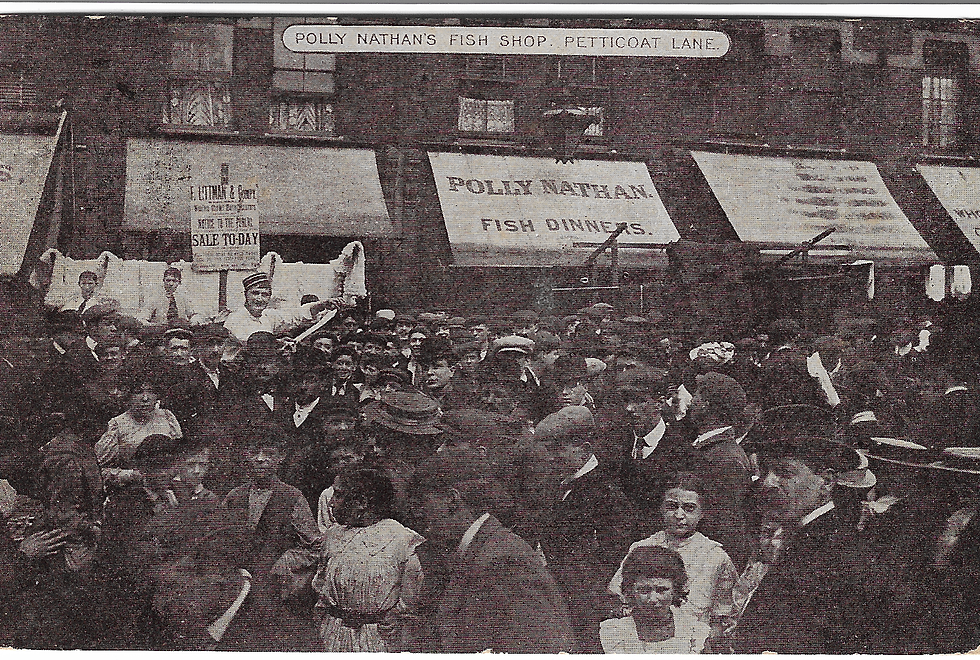
POLLY NATHAN'S FISH SHOP
Polly Nathan – known affectionately as the ‘herring queen’ – ran one of the area’s best-known fish shops in Middlesex Street, serving fried fish and pickled delights to locals of all backgrounds. Her fish shop, at 62 Middlesex Street, was a famous hotspot amongst locals and visitors alike. There are numerous images showing the exterior of the shop which suggests it was an attraction in the local area. Polly Nathan was born in 1850 and grew up in Mile End before living and working on Middlesex Street later in her life.
Polly and her family fed the hungry hoards that were out shopping or working at stalls on the Lane, or those coming or going from nearby schools and synagogues. Records show that she died in 1910 when she was nearly 60. As the average life expectancy for working class women in the late 19th century was less than 36 years old. Polly would likely have been seen as an old staple of the community.
Some of the architecture of 62 Middlesex Street, such as the decorative exterior, can still be seen today.
Researched and written by Mark